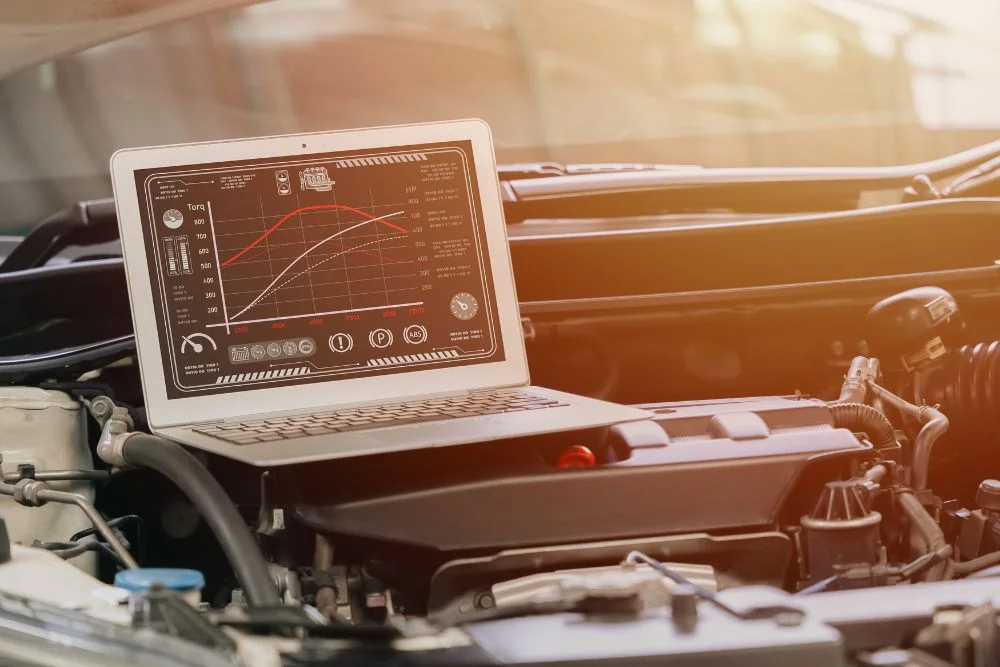
Few topics in the enthusiast community attract as much opinion as ECU calibration. The reality is considerably more nuanced than most online content suggests. This article explains what ECU calibration actually involves, what a professional session looks like, and what questions you should ask before committing to any work.
What the ECU Does
The engine control unit manages the combustion process in a modern vehicle. It receives input from sensors measuring air temperature, throttle position, crankshaft position, exhaust gas composition, coolant temperature, and many others — using this data to calculate appropriate values for fuel injection timing, ignition advance, variable valve timing, idle speed, and boost pressure on turbocharged engines.
These calculations reference a set of maps — three-dimensional lookup tables — to determine the correct output for any combination of engine speed, load, and other variables. It is these maps that calibration work can adjust.
Why Factory Maps Leave Room for Adjustment
Manufacturers develop engine management software to work reliably across a wide set of conditions. A vehicle sold across multiple markets must function in climates from Scandinavian winters to Middle Eastern summers. It must run on fuel quality varying from 91 to 97 RON. It must meet emissions standards in every jurisdiction where it is registered.
This breadth of requirements means factory calibration is a deliberate compromise — built for the widest possible operating window, not optimised for the specific vehicle you own, driven in the UK, on modern premium fuel, with a well-maintained engine. The genuine scope for calibration lies in adjusting parameters the factory set conservatively to accommodate conditions different from yours.
What a Professional Session Involves
A reputable session begins with a diagnostic check. Before any map data is read, the workshop connects to the OBD port and checks for fault codes across relevant modules. Any stored faults need addressing first — a revised fuel map applied to an engine with a failing mass airflow sensor will not produce useful results.
Once the vehicle is confirmed mechanically sound, the calibrator reads the existing map from the ECU — the baseline, stored securely before any work begins. If anything goes wrong or you want to return to factory settings at any point, this is your safety net.
The calibrator then reviews the map data and makes targeted adjustments. On a petrol engine this typically involves ignition timing advance in certain load ranges, throttle mapping, and on turbocharged engines, boost pressure where head gasket and intercooler specifications permit. The process includes a data-log run to capture engine behaviour under load, further adjustment, and a verification data-log to confirm the result is consistent.
Realistic Expectations
A professionally calibrated engine will typically feel more responsive at partial throttle openings — the area of the rev range where most real-world driving occurs. Fuel efficiency can improve on a car that was previously running rich, though this depends heavily on driving style and is not something any responsible calibrator will guarantee in figures. Outright power increase, if any, depends on how much headroom the factory map left and the mechanical condition of the engine.
Be cautious of any workshop that quotes specific power gains before examining your vehicle. Outcomes vary by make, model, year, engine condition, and fuel quality. A competent calibrator will be measured about what they expect to achieve and transparent about the reasoning.
Warranty Considerations
If your vehicle remains under active manufacturer warranty, ECU calibration can potentially void the powertrain warranty element, depending on the manufacturer and the nature of a subsequent claim. This is worth investigating carefully before proceeding. Some extended warranty products include similar exclusions. We always discuss this with customers during the initial consultation.
Emissions Compliance
Responsible calibration work does not involve removing, bypassing, or disabling emissions control systems. Catalyst removal, EGR deletion, and DPF defeat devices are outside the scope of road-legal ECU work and are not something Qorvixa undertakes. All work is carried out within the parameters required for UK MOT compliance.
Questions to Ask Any Workshop
Before committing to calibration work, consider asking: whether the original map will be stored and available for restore; what diagnostic check is performed before any adjustment; whether you will receive a data-log summary of before and after states; what equipment and calibration platform is being used; and whether the calibrator has experience with your specific engine variant. The answers will tell you a great deal about the quality and care of the operation.
Interested in ECU Calibration?
Get in touch to discuss your vehicle. We're straightforward about what's achievable.
Start a Conversation